

If you forget to drink water most days despite genuinely meaning to, you’re not alone — you buy the bottle, you set the intention, and by 2 p.m. it’s still sitting full on your desk. If that sounds familiar, the problem probably isn’t willpower — it’s a well-documented gap between intention and action that shows up across almost every health habit, not just hydration.
This isn’t a personality flaw. It’s a specific, named phenomenon in behavioral medicine, and understanding why it happens is the first step to actually closing it.
Table of Contents
The Real Reason People Forget to Drink Water
According to a StatPearls clinical review published through the National Institutes of Health, even when a behavior is completely voluntary, “actions do not always align with intentions.” Researchers have a name for this: the intention-behavior gap, defined as “the difference between what a person plans to do and what they actually do.”
That gap is exactly why so many people struggle to drink water consistently despite genuinely wanting to. Wanting to drink water and actually doing it are two separate cognitive processes, and one doesn’t automatically trigger the other.
It’s Not Just You — Adherence to Healthy Habits Is Broadly Low
The same clinical review notes something worth sitting with: the proportion of U.S. adults adhering to five key health behaviors actually fell from 15% to 8% between 1988 and 2006. If you forget to drink water some days, you’re not an outlier — you’re behaving exactly the way the research predicts most people behave when a habit depends purely on remembering.
The gap between “I should drink more water” and “I did drink more water” isn’t a discipline problem. It’s a structural one, and structural problems respond to structural fixes rather than more willpower.
Why Hydration Habits Specifically Fall Apart
Hydration is a uniquely easy habit to forget because, unlike hunger, thirst is a comparatively weak and delayed signal. You can be meaningfully behind on drink water before your body sends a clear enough cue to notice, which means the habit has to be built on an external reminder rather than an internal one — at least at first.
The Habit Formation Timeline
The same NIH-published review breaks habit formation into three stages: initiation, when the behavior and its cue are first established; learning, when repetition strengthens that association; and stability, when the behavior (drink water) finally becomes automatic. One frequently cited study found this process takes an average of 66 days, though the research is clear that the real number varies widely by person and by behavior.

That’s the practical takeaway for anyone trying to remember to drink water more consistently: the habit isn’t supposed to feel automatic in week one. It’s supposed to feel effortful right up until it doesn’t, and the entire purpose of an external reminder is to carry you through that middle stretch.
Why “Just Remember” Doesn’t Work as a Strategy
Telling yourself to just remember to drink water is, ironically, one of the least effective strategies available. The intention-behavior gap exists precisely because intention and memory-in-the-moment are not the same mental resource. You can want something intensely at 9 a.m. and have zero access to that intention by 1 p.m. once you’re deep in a task, a meeting, or a stressful afternoon.
This is why the research consistently points toward external structure — a cue, a plan, a prompt — rather than internal motivation as the more reliable lever for actually changing behavior ( drink water).
Desk Jobs and Screen Time Make the Gap Wider
Anyone working at a desk for long stretches is fighting an environment that actively works against this habit. A focused work block can absorb ninety minutes or more without a single natural break, which is exactly the kind of stretch where an internal thirst cue gets buried under whatever task is in front of you.
Remote and hybrid workers face a version of the same problem in a different form: without the incidental cues of an office — walking to a meeting room, passing a shared kitchen, coworkers getting up for water — there are fewer built-in moments where reaching for a glass happens naturally. The habit has to be manufactured deliberately instead of borrowed from the environment, which is precisely why an external reminder tends to matter more, not less, for anyone working from a single room most of the day.
What Actually Closes the Gap, According to the Research
If willpower isn’t the fix, what is? Two mechanisms show up repeatedly in the behavioral literature, and both are directly relevant to anyone trying to drink more water consistently.
Implementation Intentions: The “If-Then” Plan
The NIH-published review highlights implementation intentions as “one practical bridge from intention to action” — brief if-then plans that specify exactly when, where, and how a behavior will happen. Instead of a vague goal like “drink more water today,” an implementation intention sounds like “if it’s 10 a.m. and I’m at my desk, then I drink a full glass of water.”
Meta-analyses cited in the same review found implementation intentions genuinely improve healthy dietary behaviors and increase physical activity. The mechanism isn’t mysterious: a specific if-then plan removes the need to remember and decide in the moment, which is exactly the point where most hydration habits break down.
Reminder-Based Cues: What the Data Actually Shows
Implementation intentions work well on paper, but most people need something that fires the cue for them rather than relying on memory to trigger the plan when it’s actually time to drink water. This is where reminder-based tools earn their place, and there’s real data behind that specific mechanism.
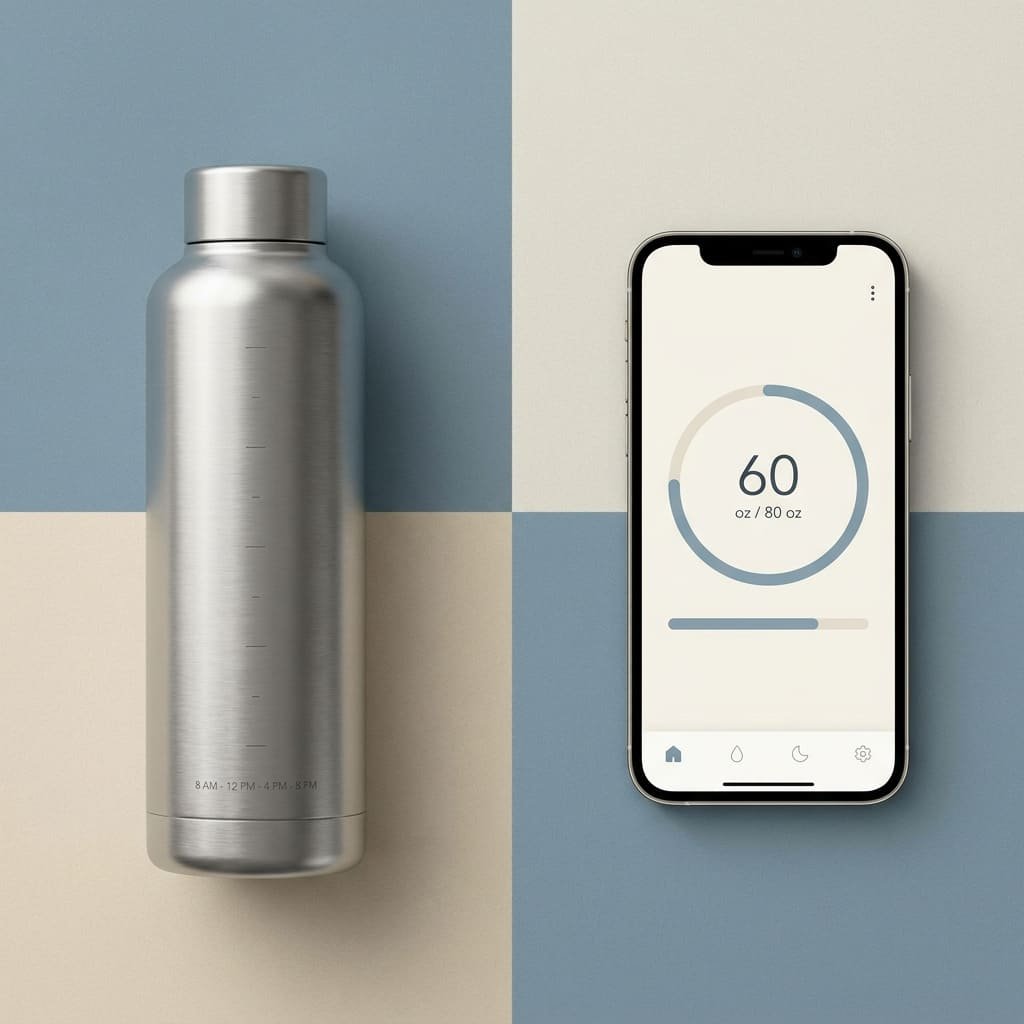
A pilot study published in the peer-reviewed Journal of Exercise and Nutrition tested two different reminder interventions over five weeks — one using a motivational water bottle, the other using a reminder and tracking app. Both groups increased their water intake by an average of 29%, reaching a mean daily consumption that met standard recommendations, with no significant difference between the two reminder methods.
That last detail matters. The specific format of the reminder — bottle-based or app-based — mattered less than simply having a consistent external cue in place at all. What worked wasn’t a particular gadget; it was the presence of a reliable prompt, repeated often enough to bridge the gap between intention and action.
Where a Smart Water Bottle Fits Into This
This is exactly the mechanism behind a smart water bottle’s reminder feature, and it’s worth being precise about why it works rather than repeating marketing shorthand. It isn’t because most people are secretly, severely dehydrated — our fact-check of the specific dehydration statistic used to market these products found that claim doesn’t hold up against the clinical literature. It’s because a periodic, external prompt is one of the two research-supported ways to close the intention-behavior gap.
A Bluetooth-connected bottle that pings your phone at set intervals is, functionally, an automated implementation intention — it hard-codes the “if this time has passed, then drink water” plan so you don’t have to hold it in your head all day. That’s a legitimate, evidence-aligned reason to use one, independent of whichever statistic happens to be printed on the packaging.
If you’re curious what a fact-checked breakdown of one specific model looks like in practice, our smart water bottle review walks through the WATERH Boost claim by claim, separating the parts of the marketing that hold up from the parts that don’t.
What to Look for If You Try a Reminder-Based Approach
Not every reminder tool is built the same way, and a few details determine whether it actually closes the gap or just adds another notification you learn to ignore.
- A customizable interval — research on reminder effectiveness suggests personalized timing outperforms generic, evenly spaced pings.
- A realistic default target — a fixed daily number works better as a starting point you can adjust than a rule you’re expected to hit exactly.
- Passive tracking, not just alerts — seeing actual progress toward a goal reinforces the habit during the learning stage described above.
- Low friction to respond — a reminder you can act on in five seconds (drink from the bottle already in your hand) beats one that requires opening an app and logging something first.
- Durability past the first few weeks — since habit formation research suggests it can take well over a month to become automatic, the tool needs to survive longer than initial motivation does.
None of these criteria require any particular brand. They’re just the practical translation of what the implementation-intention and reminder-cue research actually recommends.
It’s also worth deciding upfront whether you want a tool that just prompts you or one that also logs what you drink. The pilot study referenced above tested both a plain motivational bottle and a full tracking app, and neither format outperformed the other — so this is genuinely a matter of personal preference rather than one option being more “scientifically correct” than the other. Some people find logging motivating; others find it adds friction they’ll eventually abandon. Pick the version you’re more likely to still be using in month two, since that’s the point where the habit is supposed to start becoming automatic.
Signs the Intention-Behavior Gap Might Be Affecting Your Hydration
A few patterns tend to show up specifically when the gap — not a lack of desire — is the real obstacle:
- You genuinely intend to drink more water in the morning but realize by afternoon you’ve had almost none.
- You only remember when you’re already thirsty, which research shows is a late, unreliable signal.
- You’ve tried “just remembering” multiple times and it’s worked for a few days before quietly fading.
- A full water bottle sits visibly on your desk for hours without being touched.
- You hydrate more consistently on days with an external structure — a workout, a meeting schedule — than on unstructured days.

If several of these sound familiar, the research suggests the fix isn’t trying harder to remember. It’s removing the need to remember in the first place, and the good news is that this particular fix doesn’t require overhauling your entire routine — a single reliable cue, repeated consistently, is what the data points to as the actual lever.
Frequently Asked Questions
Why do I forget to drink water even though I want to stay hydrated? Because wanting to do something and actually doing it rely on different cognitive processes. Researchers call the space between them the intention-behavior gap, and it affects most health habits, not just hydration specifically.
How long does it take to build a hydration habit that sticks? Habit formation research suggests an average of around 66 days before a behavior becomes automatic, though the real range varies significantly by person and by how the habit is structured.
Do reminder apps or reminder bottles actually work, or is it just a gimmick? A peer-reviewed pilot study found both reminder-app users and reminder-bottle users increased their water intake by an average of 29% over five weeks, with no meaningful difference between the two formats — the consistent external cue was what mattered.
Is a smart water bottle better than just setting phone alarms? Not necessarily better, but often lower-friction, since the reminder and the action (drinking from the bottle in your hand) happen in the same place. The underlying mechanism — an external cue closing the intention-behavior gap — is the same either way.
What’s an implementation intention, in plain terms? It’s a specific if-then plan, like “if it’s 10 a.m., then I drink a glass of water,” rather than a vague goal like “drink more water today.” Research shows this specificity meaningfully improves follow-through.
Do I actually need to worry about the “75% of people are dehydrated” statistic? No — that particular figure has been fact-checked and doesn’t hold up against the clinical literature. Reminder-based hydration tools are still worth considering, just for a more honest reason: closing a documented gap between intention and follow-through.
The Bottom Line
If you keep forgetting to drink water despite genuinely wanting to, that’s not a discipline failure — it’s the intention-behavior gap doing exactly what the research says it does. The fix isn’t more motivation. It’s a specific plan and a reliable external cue, whether that’s an if-then rule you set for yourself or a reminder tool that sets it for you automatically.
The data on reminder interventions is genuinely encouraging: a 29% average increase in water intake over five weeks, driven by consistency rather than any particular gadget. Whatever tool you choose, the mechanism that makes it work is the same one behavioral researchers have been documenting for years — and it has nothing to do with willpower.
This article reflects publicly available research from peer-reviewed and government sources and is not medical advice. Consult a healthcare provider about your individual hydration needs, especially if you have a medical condition that affects fluid balance.
[…] seeking to optimize their daily fluid intake alongside topical regimens can review our guide on forget to drink water for practical hydration […]