


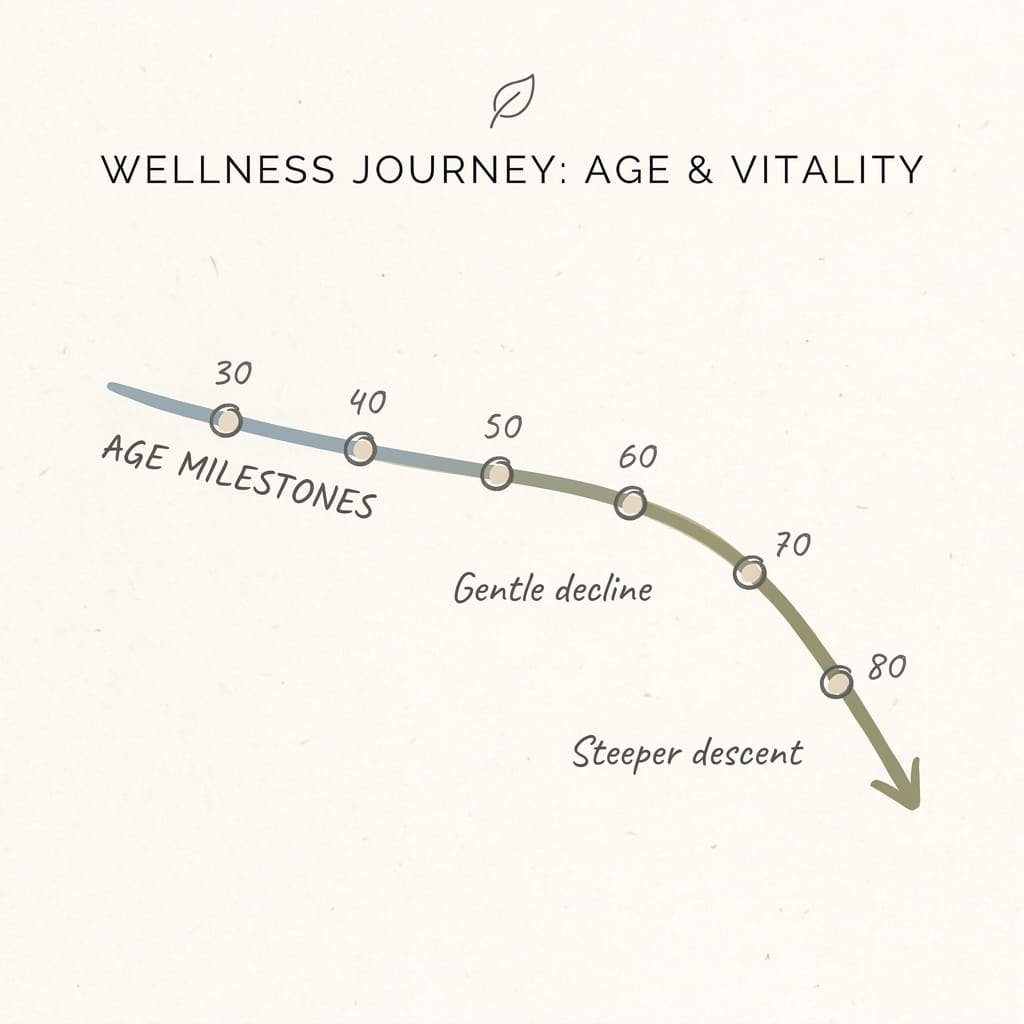
Muscle loss doesn’t announce itself. There’s no single bad week where it suddenly shows up — it’s a slow drift that starts decades before most people notice it, and by the time it’s obvious, a meaningful amount of ground has already been lost. Here’s what actually happens to your muscles, decade by decade, starting earlier than you’d probably guess.
This timeline isn’t meant to be alarming. It’s meant to be useful — the earlier you understand where you actually are in this process, the more leverage you have to do something about it while the changes are still small and easy to offset. Most of the numbers below come from the same handful of well-established clinical sources, laid out chronologically rather than as a single statistic dropped into a paragraph, so you can see exactly where the curve bends and when.
Table of Contents
Your 30s: The Quiet Start
Muscle loss typically begins around age 30, according to the Office on Women’s Health, part of the U.S. Department of Health and Human Services. At this stage, the body naturally loses about 3 to 5 percent of muscle mass per decade — a small enough number that it’s essentially invisible in daily life.
Nothing about your 30s feels different because of this. Strength, energy, and physical capability generally still feel stable, since the loss is gradual and the body compensates well at this stage. This is also the decade with the most leverage: intervening early costs far less effort than trying to rebuild lost ground later, since you’re working against a small deficit rather than years of accumulated loss.
For most people in their 30s, life is also genuinely busy — careers, families, and other priorities tend to push physical training further down the list, which is part of why this particular window of opportunity gets missed so often. There’s no symptom pushing you toward resistance training at this stage, just a quiet, compounding process that won’t become obvious for years, which makes it one of the easiest health issues to deprioritize indefinitely.
Your 40s: Still Under the Radar
The 3 to 5 percent per-decade rate generally continues through the 40s. Most people still don’t notice anything specific — no dramatic strength drop, no obvious physical change — but the cumulative loss from the 30s and 40s combined is no longer trivial.
This is often the decade where the first small signs creep in: recovery from workouts takes slightly longer, or a previously easy physical task feels marginally more effortful. Most people attribute this to being “busier” or “more tired” rather than connecting it to gradual muscle loss, since nothing about it feels acute.
It’s also a decade where many people’s activity levels start to decline for reasons unrelated to aging itself — desk jobs, family obligations, and general schedule pressure all tend to reduce the kind of regular resistance activity that would otherwise help offset this baseline loss, compounding the biological process with a behavioral one that isn’t strictly necessary.
Your 50s: Measurable Change Begins
By the 50s, research shows muscle loss becomes measurable in ways it wasn’t before. Reductions in grip strength and walking speed — two of the standard clinical markers used to assess muscle function — typically become detectable starting around this age, according to research on age-related muscle decline.
This is also the decade where hormonal changes, particularly around menopause for women, can accelerate the underlying process. The 3 to 5 percent per-decade baseline can start to climb for some people during this stretch, though the exact rate varies significantly based on activity level, diet, and individual health factors.
For men, testosterone levels also begin a gradual decline during this period, which some research links to accelerated muscle loss as well, though the relationship is less consistently studied than the hormonal changes associated with menopause. Either way, the 50s tend to be the decade where the abstract idea of “muscle loss” starts becoming something people can actually feel in day-to-day life, even if only subtly.
Your 60s: The Acceleration Point
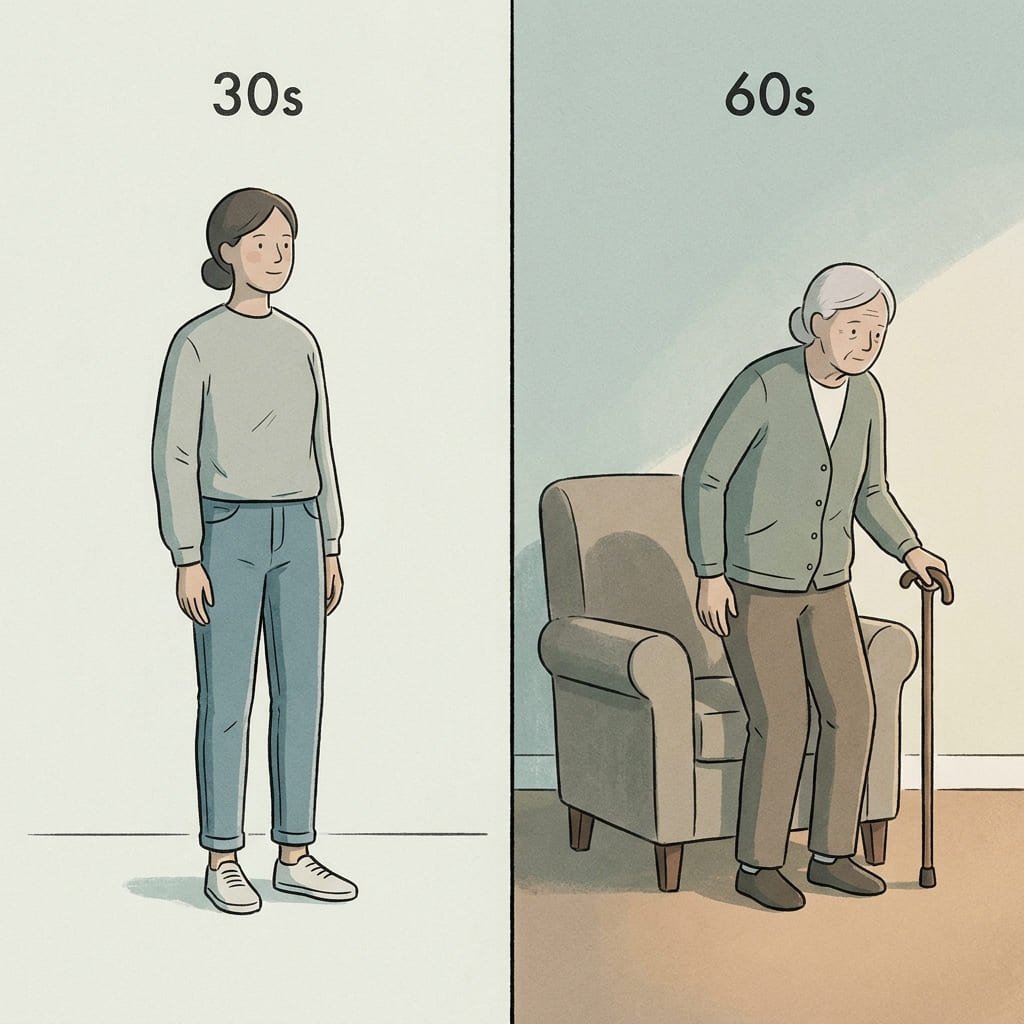
This is widely described as the point where muscle loss “speeds up.” According to Cleveland Clinic, the rate of loss can climb as high as 8 percent per decade starting in this range, roughly double the baseline rate from the 30s and 40s. Some research puts the increase even earlier, describing acceleration beginning between ages 65 and 80 specifically.
Sarcopenia — the clinical term for muscle loss severe enough to affect strength and daily function — starts showing up in a measurable share of the population during this decade. Estimates vary by study and diagnostic criteria, but figures in the range of 10 to 20 percent of adults over 60 are commonly cited.
This is also often the decade where people first notice muscle loss in a way that actually changes daily behavior — stairs feel harder, carrying groceries takes more effort, or getting up from a low chair requires a visible push rather than a smooth motion. These are exactly the kinds of functional changes that formal sarcopenia screening tools are designed to catch, often using a simple questionnaire alongside grip strength testing.
Your 70s: When Function Starts to Matter More Than Mass
By the 70s, the conversation shifts somewhat from muscle mass to muscle function — strength and the ability to perform daily tasks matter more clinically than the raw amount of muscle tissue itself. Research shows strength is typically lost two to five times faster than muscle mass itself, which is part of why grip strength and walking speed are used as the primary functional markers at this stage rather than mass alone.
Sarcopenia prevalence continues climbing through this decade, with commonly cited estimates in the 20 to 30 percent range for adults in their 70s, depending on the study population and diagnostic threshold used. This is also the decade where the consequences of muscle loss start intersecting more directly with fall risk, since strength and balance are closely linked functionally, and a fall at this age carries meaningfully higher risk of serious injury than the same fall would at 40.
Your 80s and Beyond: The Steepest Curve
This is where the numbers become hardest to ignore. Estimates of sarcopenia prevalence in adults over 80 range from roughly 11 percent to as high as 50 percent, depending on the diagnostic criteria used — a wide range, but one where even the low end represents a substantial share of the population.
At this stage, muscle loss isn’t an abstract statistic anymore for a large number of people — it’s directly tied to mobility, independence, fall risk, and the ability to manage daily tasks without assistance. The wide range in prevalence estimates also reflects something encouraging: individual outcomes at this age vary enormously based on activity history, meaning the trajectory isn’t fixed for everyone equally. People who maintained resistance training through their 50s, 60s, and 70s generally land closer to the lower end of that prevalence range than those who didn’t.
Why This Timeline Matters More Than It Seems
The pattern across all six stages is consistent: the earlier the decade, the smaller and more reversible the changes tend to be, and the later the decade, the more the accumulated loss compounds into something that affects daily function. That makes the 30s and 40s — the decades where nothing feels different yet — arguably the highest-leverage window for doing something about it.
Physical exercise, and resistance training specifically, remains the only intervention with strong, consistent evidence behind it for slowing this process, according to research on age-related muscle decline. Nutrition plays a supporting role alongside training rather than as a standalone fix, and no supplement, diet, or lifestyle change has been shown to meaningfully slow muscle loss without a resistance-training component behind it.
This is worth repeating because it cuts against a lot of supplement marketing that implies a pill or powder alone can substitute for the mechanical stress that triggers muscle growth. Nothing currently on the market does that — the training itself is doing the actual work, and anything else is, at best, support for that primary driver rather than a replacement for it.

What Actually Helps Across Every Decade
Resistance training is the foundation, and it matters at every stage of this timeline, not just after muscle loss becomes noticeable. Even light resistance work in your 30s and 40s builds a buffer against the losses that accelerate later, and there’s no evidence of an age too young to benefit from starting.
Adequate protein intake supports the muscle-building process that resistance training triggers, and research increasingly points to creatine monohydrate as a well-studied addition specifically for older adults engaged in resistance training, alongside its more commonly discussed use for younger athletes. We covered the research behind one specific creatine monohydrate product, including what the evidence actually supports and where the marketing tends to overreach, in our creatine monohydrate review, if you want to look at that option specifically.
None of this requires waiting until muscle loss becomes a visible problem. The research consistently points toward starting resistance training and adequate protein intake well before the accelerated decades, rather than treating it as a fix reserved for later in life. Two or three sessions a week, targeting the major muscle groups, is generally enough to make a measurable difference over time — this doesn’t require an elite training program, just consistency applied over years rather than weeks.
Frequently Asked Questions
At what age does muscle loss actually start? Around age 30 for most people, though the rate is slow enough in the 30s and 40s that it’s rarely noticeable without formal testing like grip strength or muscle mass measurement.
Can muscle loss be reversed, or only slowed? Resistance training has been shown to rebuild muscle mass and strength at virtually any age, including in adults already experiencing sarcopenia, though starting earlier makes the process considerably easier.
Is muscle loss the same as sarcopenia? Not exactly — muscle loss is the general process that begins around age 30, while sarcopenia refers specifically to loss severe enough to affect strength and physical function, typically diagnosed later in the timeline.
Does diet alone prevent muscle loss without exercise? No — nutrition supports the muscle-building process, but resistance training is the intervention with the strongest evidence for actually slowing or reversing muscle loss on its own.
Why does muscle loss accelerate around age 60? The exact mechanisms are still studied, but hormonal changes, reduced physical activity, and declining protein synthesis efficiency are all thought to contribute to the acceleration seen in this range.
How much muscle loss is considered normal versus a sign of sarcopenia? The 3 to 5 percent per-decade baseline from the 30s through roughly the 50s is generally considered a normal part of aging; sarcopenia is diagnosed when loss reaches a level that measurably affects strength and daily function, typically assessed through grip strength and walking speed tests rather than muscle loss percentage alone, since function tends to be the more clinically meaningful measure.
The Bottom Line
Muscle loss starts far earlier than most people assume, and it compounds quietly for decades before becoming a visible problem. The good news is that the intervention that matters most — resistance training — works at every stage of this timeline, from the invisible losses of your 30s to the more consequential losses of your 70s and 80s.
The earlier you start, the smaller the problem you’re actually solving. Waiting until muscle loss becomes noticeable means working against a much larger deficit than someone who started building a buffer decades earlier — the biology doesn’t change, but the size of the gap you’re closing does, and that gap is far easier to close in your 30s than it is to close in your 60s.
This article is for general informational purposes and is not medical advice. Talk to a healthcare provider about your individual risk factors and an appropriate exercise and nutrition plan, especially if you’re managing an existing health condition or noticing functional changes like reduced grip strength or slower walking speed.
[…] disease risk. To understand how age influences physical decline, inspect our detailed breakdown on Muscle Loss by Decade. Incorporating exercise snacks for sedentary workers that feature light weight resistance or […]